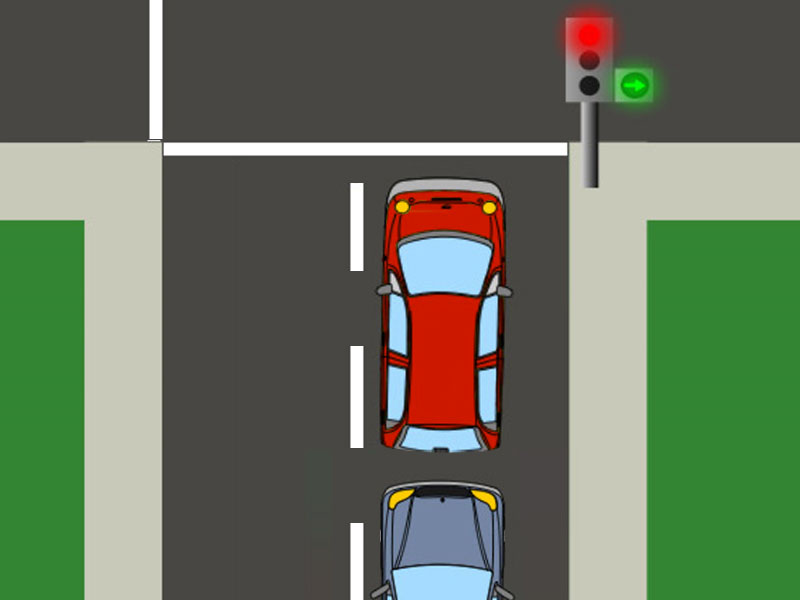
The driver of the red vehicle intends to go straight on. The main traffic light is red and the auxiliary light shows a green right-turn arrow. Should the red vehicle move forward so as not to block the blue vehicle behind, which wants to turn right?
- A)Yes. It is in the lane that traffic turning right has to use, so when the green arrow lights up it must move forward in the direction of the arrow.✓ Correct answer
- B)No, because there is no left-hand lane available to move into in this situation.
- C)No, because the main traffic light is red.
Why this is the correct answer
The main light is red, but the auxiliary light shows a green arrow on a black background. A green arrow allows vehicles to go in the direction it shows, whatever the main light shows. Any vehicle that is in a lane reserved for that direction, or in the lane that traffic going that way has to use even if it is not reserved (here, the right-hand lane), must move forward in the direction of the arrow when it lights up. The red car is in the right-hand lane, so it must turn right carefully, giving way to vehicles in the road it joins and to pedestrians crossing, and must not block the blue car behind it. To go straight on, it should have chosen the correct lane earlier. Option B is wrong because the rule does not depend on whether there is another lane to move into. Option C is wrong because the green arrow allows the turn even though the main light is red. Remember: choose your lane in advance, according to the direction you want to take.
More questions about traffic signs & signals
- The reversible lane on your left is open to traffic coming towards you, and the signal above it shows a red X. Are you allowed to cross the double broken line on your left to overtake?
- When a vertical sign contradicts a fixed beacon, which one takes precedence?
- The yellow car in the picture is stopped because its driver wants to go straight ahead. According to the signage, what should it do?
- At the sign depicted in the image, what must you do?