
Is this car permitted to pull over?
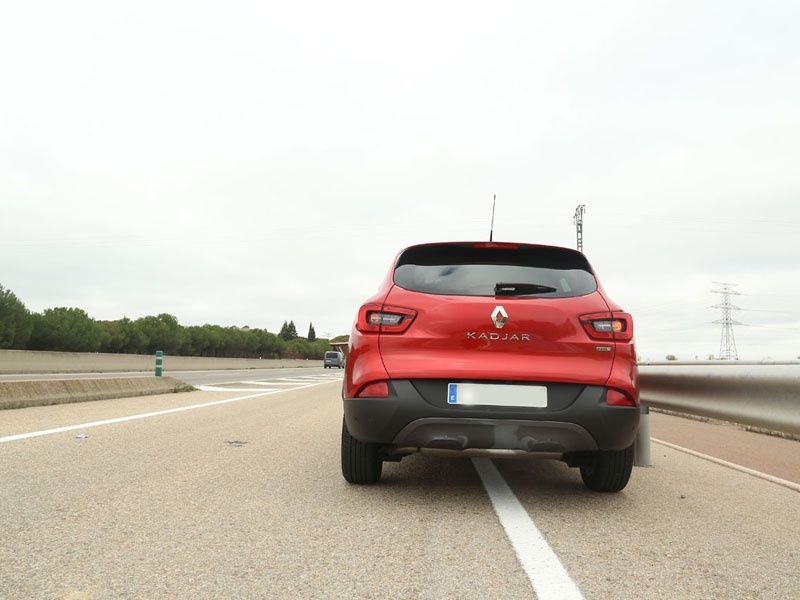
- A)Yes, because it is signalling to the right and does not obstruct traffic.
- B)Yes, if the pull over is due to an emergency.
- C)No, because there is less than 3 metres between the car and the line.✓ Correct answer
Why this is the correct answer
According to Spanish traffic regulations, pulling over or parking is considered dangerous and a serious obstruction to traffic when the distance between your vehicle and the opposite edge of the road — or a continuous longitudinal line (centre line) that cannot be crossed — is less than 3 metres. In the photo, the car has stopped on the right side of the road, but the space between the vehicle and the white continuous centre line is clearly less than 3 metres. This means other vehicles cannot pass without crossing the continuous line, which is illegal. Therefore, this pull-over is NOT permitted. Important: voluntary stop vs. total breakdown. This question is about a voluntary pull-over — a deliberate decision to stop. The 3-metre rule applies to all voluntary stops and parking manoeuvres. Option B ("Yes, if the pull over is due to an emergency") is a deliberate distractor: the image shows a car that has chosen to stop, not one that has broken down. But what if your car breaks down completely and you cannot move it at all? That is a different legal situation. A total mechanical failure is a forced immobilisation, not a voluntary stop. In that case, Spanish traffic rules do NOT punish you for where the car ended up — you had no choice. However, you still have legal obligations: 1. Turn on your hazard lights immediately. 2. Activate your V-16 emergency beacon (mandatory since January 2026) and place it on the highest point of your vehicle to warn other drivers and alert the DGT 3.0 platform. 3. If safe to do so, exit the vehicle on the side away from traffic and move to a safe area off the road. If it is not safe to exit, stay inside with your seatbelt fastened. 4. Call roadside assistance so the vehicle can be removed as quickly as possible. Remember: the 3-metre rule is about where you are ALLOWED to stop voluntarily. A genuine breakdown where you cannot move the car is handled differently — but you must still signal the danger and get the vehicle removed promptly. Key rule for the exam: always ensure at least 3 metres of free space between your stopped vehicle and any continuous centre line or the opposite edge of the road, so that other traffic can pass safely without crossing a solid line.
More questions about traffic regulations & road use
- Is it permissible to park a motorcycle on the pavement?
- On the inter-urban road shown in the image, is it permissible to pull over or park on the passable unpaved hard shoulder?
- In what type of environment does vehicle driving occur?
- On a very steep and narrow road where two vehicles cannot pass, which vehicle should give way?