
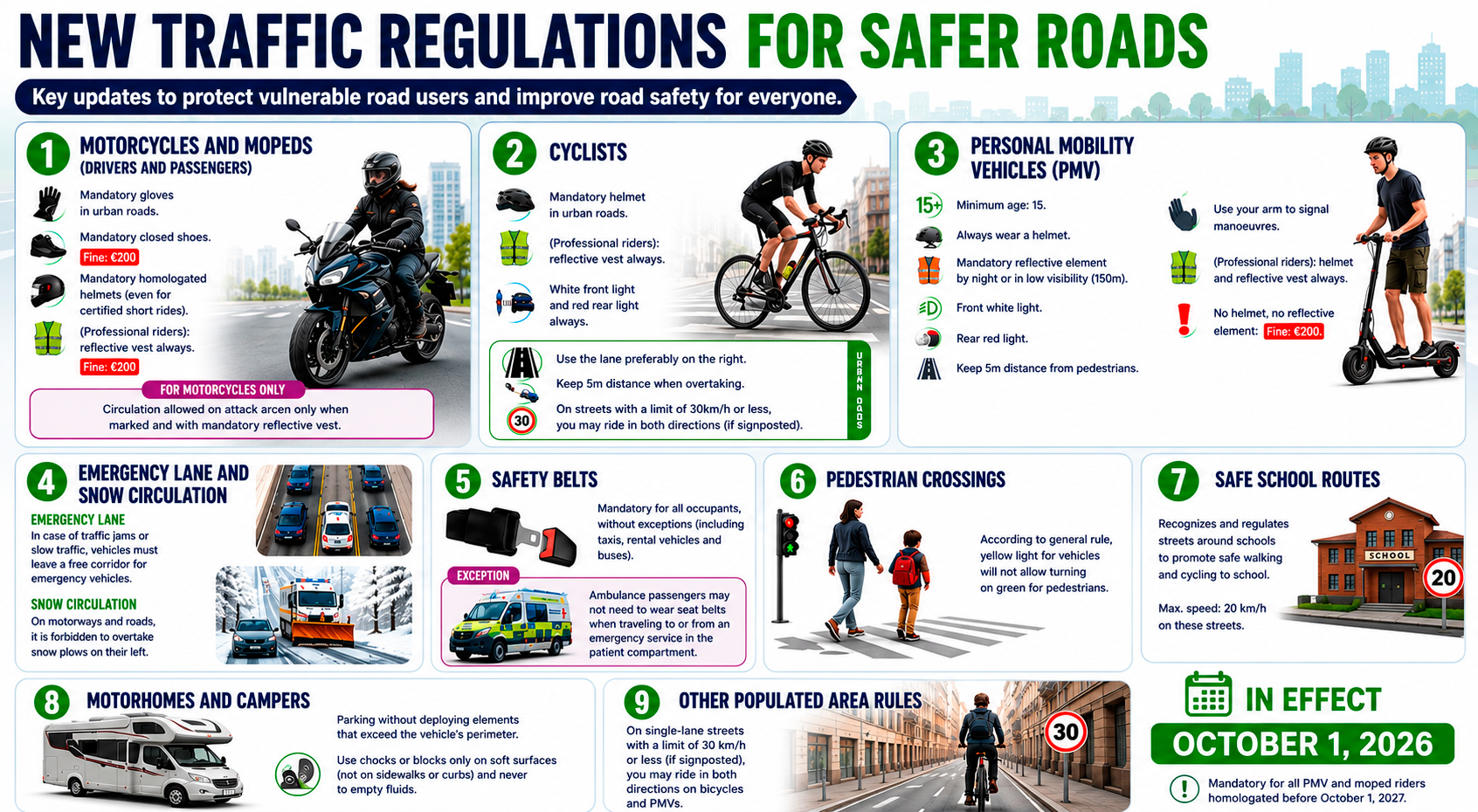
New Spanish Traffic Rules from October 2026: What Changes for Your Theory Test
Spain has approved the biggest reform of its traffic regulations in years. Royal Decree 518/2026, published in the official state gazette on 26 June 2026, comes into force on 1 October 2026 and shifts the focus of the rules towards protecting what the law now calls vulnerable road users: pedestrians, cyclists, riders of electric scooters, motorcyclists and moped riders.
If you are sitting your DGT theory test from October onwards, these rules can appear in your exam. Here is what changes, in plain English.
Overtaking cyclists: it is no longer just 1.5 metres
You already knew you must leave at least 1.5 metres of lateral clearance when passing a cyclist. Two things are added outside built-up areas:
- You must reduce your speed by at least 20 km/h below the limit for the road while you complete the manoeuvre. On a road limited to 90 km/h, that means overtaking at no more than 70 km/h.
- Where the road has more than one lane in your direction, you must change lane completely instead of edging across.
The same clearance and the same speed reduction apply when you pass a broken-down vehicle, an emergency services vehicle attending an incident, a pedestrian or an electric scooter.
The new emergency corridor
This one is completely new in Spain and is very likely to appear in exams. When traffic stops or slows to walking pace on a motorway or dual carriageway, drivers must pull aside to open a free corridor for the emergency services, without waiting to be asked:
- With two lanes, the corridor forms down the middle.
- With three or more lanes, it forms between the far-left lane and the one next to it.
Motorcycles and mopeds: more compulsory kit
- Gloves become compulsory on interurban roads, and closed footwear covering the whole foot on any road, for rider and passenger alike.
- Every motorcycle must carry a high-visibility reflective vest. You do not have to ride wearing it: you put it on when you get off the machine on an interurban road, for example after a breakdown.
- Helmets for moped riders must now be type-approved, not merely certified, with a one-year transitional period.
- Intercom devices built into the helmet are expressly allowed for rider-to-passenger communication or navigation, provided they are certified or type-approved. Ordinary headphones connected to music players remain banned.
- In congested traffic, on signposted stretches only, motorcycles may use the right-hand hard shoulder in single file and at no more than 30 km/h.
Electric scooters get real rules at last
- Minimum age to ride one in a public space: 15 years.
- Helmet is compulsory for every rider, at any age.
- Riding on the pavement is banned outright, with no exception for going slowly.
- They are also banned from interurban roads, except on cycle paths and similar routes.
Cyclists in town
A whole new section of the regulation is devoted to urban traffic. Cyclists now ride in the centre of the lane rather than hugging the kerb, and drivers must keep at least five metres from a bicycle ahead of them in the same lane. Cyclists may also pass queueing traffic on either side to reach the advanced stop line at junctions.
Helmets are compulsory for cyclists on interurban roads, for anyone under 16 on any road, and for anyone who works by bicycle, including in town.
Pedestrians and shared spaces
Pavements are confirmed as space for pedestrians only, and councils lose most of their power to allow motorcycle parking on them. The reform also regulates single-surface streets, where carriageway and pavement sit at the same level and the pedestrian has priority everywhere, and creates safe school routes with traffic calming around schools.
One more change that is easy to miss
A bus carrying standing passengers, or passengers who are not wearing a seat belt, is now limited to 80 km/h on every road outside a built-up area, motorways included. Previously that limit applied only to conventional roads.
Will this be in my exam?
The rules apply from 1 October 2026, so if your exam is on or after that date you should study them. Question banks that have not been updated will still teach you the old answers, which is exactly how people lose marks after a reform.
We have already reviewed our full question bank against the new text of the regulation and updated every affected question and explanation, so what you practise here matches what the law says today. Log in and take a test to check where you stand on the new rules.